
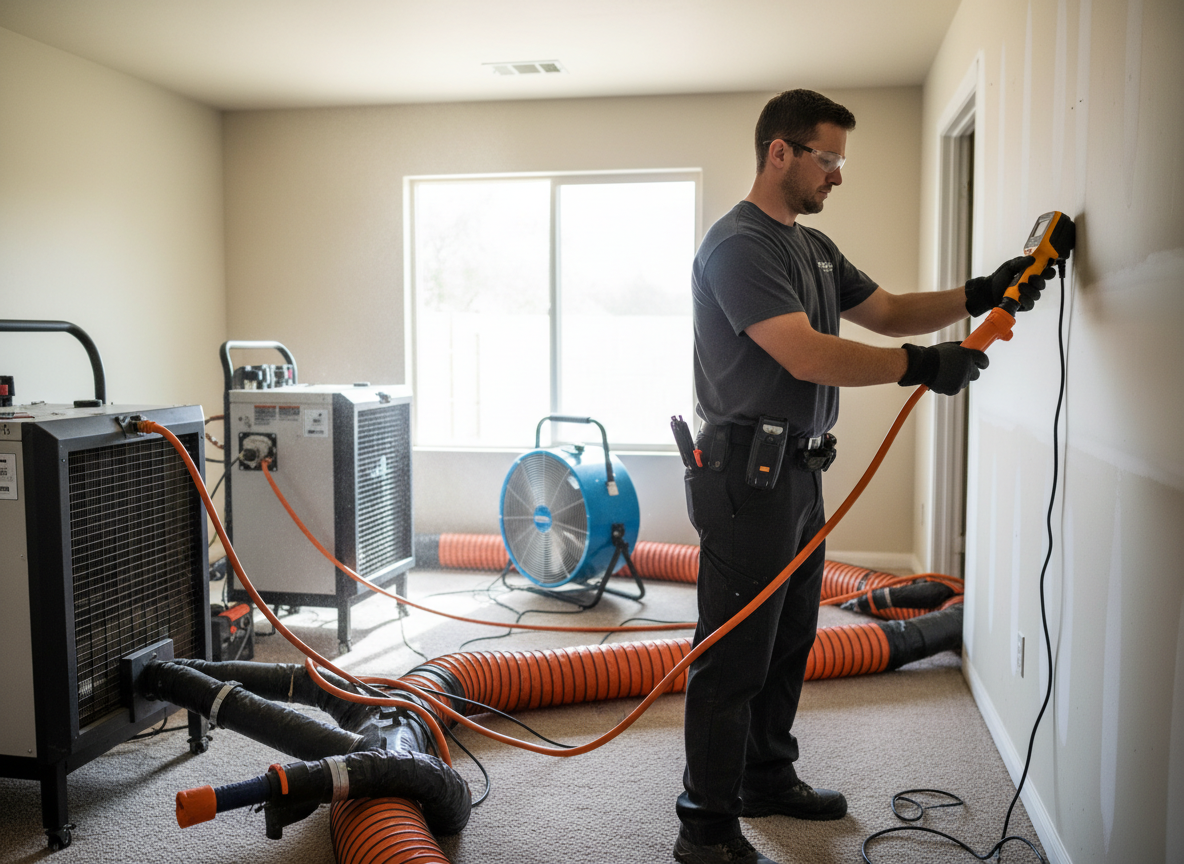
In Mesa’s hot desert climate, standing water evaporates fast on the surface but lingers inside wall cavities, under slabs, and behind baseboards. Homes in older Downtown Mesa neighborhoods often have plaster over lath or early drywall that holds moisture differently than newer builds in Superstition Springs. We use moisture meters and thermal imaging to map saturation before placing commercial dehumidifiers and air movers in patterns that account for the low humidity outside and the high indoor AC loads that can actually pull moisture back into materials if drying is rushed.
Extreme summer temperatures above 110°F force us to adjust equipment daily because rapid surface drying can trap moisture deeper in Red Mountain stucco walls or concrete foundations common across Maricopa County. We monitor relative humidity and grain depression every four hours rather than relying on preset timers. This prevents the mold blooms that appear weeks later when monsoon moisture spikes and homeowners have already turned their AC back on.
We also address the unique challenges of drying around electrical outlets, HVAC returns, and kitchen cabinetry where particle board swells permanently if left above 16% moisture content. In Tempe-adjacent homes with slab-on-grade construction, we often pull baseboards and drill small weep holes at the toe-kick to allow airflow under cabinets without full demolition. Every job ends with documented drying logs that show when materials returned to equilibrium moisture levels for the local climate.
Technician insight
In Mesa the thing that catches most people out with Structural Drying & Dehumidification is assuming the job is finished once surface water is gone. Older plaster homes in Downtown Mesa and slab homes near Riverview Park hold moisture that only shows up after the AC cycles back on during our 110-degree days.
Hidden Moisture Behind Kitchen Cabinets
A Red Mountain homeowner called after a supply line leak soaked the toe-kick area. Meters showed elevated readings behind the cabinets and under the slab edge. We pulled the baseboards, set up cavity drying wands and a slab mat system, then ran equipment for four days while monitoring daily. Final readings confirmed safe levels before we reinstalled trim.
Structural Drying & Dehumidification Services We Offer
✓Moisture Mapping and Assessment
Pinpoint hidden saturation in walls, floors and ceilings using meters and thermal cameras before equipment placement.
✓Industrial Dehumidifier Placement
Position low-grain refrigerant units sized for Mesa square footage and current outdoor humidity to pull moisture efficiently.
✓Air Mover Circulation Setup
Create directed airflow patterns that reach cavities and underfloor spaces without spreading dust in occupied homes.
✓Wall Cavity Drying
Remove baseboards and use negative-pressure or positive-air injection to dry insulation and framing in Red Mountain and Downtown Mesa homes.
✓Concrete Slab Drying
Apply specialized mats and high-volume air to pull trapped water from slabs common in Superstition Springs properties.
Structural Drying & Dehumidification Cost in Mesa, AZ
| Service | Typical Range | What Affects It |
|---|---|---|
| Single-room drying setup | $450–$850 | Moves with equipment count and days needed |
| Whole-home structural drying | $1,200–$2,800 | Larger in older Downtown Mesa homes with plaster |
| Wall cavity or slab drying add-on | $300–$600 | Common in Red Mountain and Superstition Springs properties |
| Daily equipment rental extension | $150–$300 per day | After initial three-day package |
Ranges are typical for Mesa, AZ and confirmed with an exact written quote before any work starts.
How it works
- 1
Initial Assessment
We arrive with meters and cameras, document all affected materials, and create a drying plan specific to your Mesa neighborhood and construction type.
- 2
Equipment Setup
Place dehumidifiers, air movers, and cavity drying tools in calculated positions while protecting finished surfaces and maintaining safe egress.
- 3
Daily Monitoring
Return every 24 hours to check moisture readings, adjust equipment, and record progress until materials reach safe equilibrium levels.
- 4
Final Verification
Remove equipment only after all readings meet industry standards, then provide written drying logs for your records.
Pricing
Pricing depends on square footage affected, number of rooms, and whether cavities or slab drying are required.