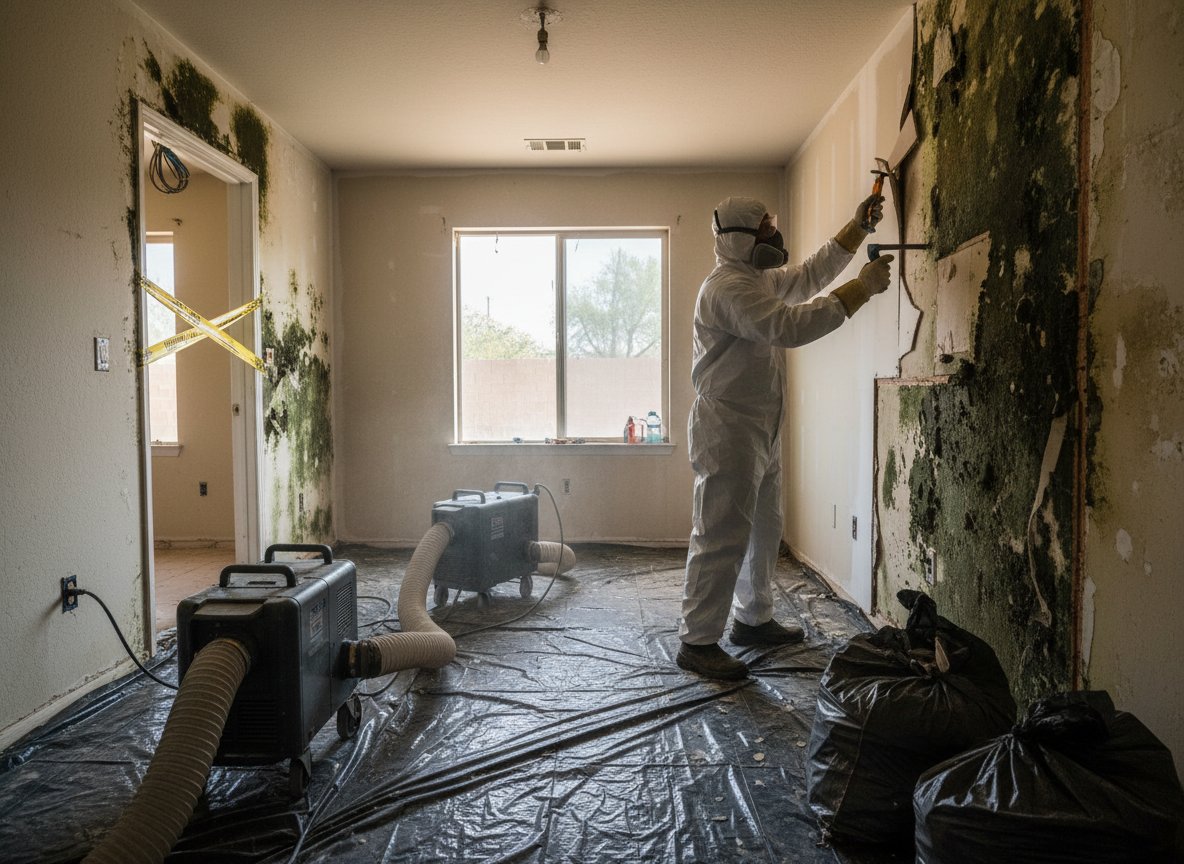
Mesa homes built before 1990 in Downtown Mesa and along Red Mountain often feature older drywall and stucco assemblies that trap moisture behind walls after monsoon leaks or appliance failures. In the extreme summer heat, standing water can drive mold growth within 48 hours, requiring immediate negative-air containment and HEPA filtration to prevent spores from migrating into HVAC systems common in Maricopa County tract homes. Technicians must account for the porous block foundations and limited crawlspace access typical here, which complicate full removal without disturbing adjacent finishes.
After initial extraction, crews focus on hidden growth in attics and behind cabinets where Superstition Springs tract homes retain humidity despite the desert air. Desiccant dehumidifiers are preferred over standard units because daytime temperatures above 110°F can push moisture back into materials if drying is not aggressive. All affected porous materials such as carpet pad, baseboard, and insulation are removed to code-minimum clearance distances, with post-remediation verification using moisture meters calibrated for local stucco and adobe substrates.
Edge cases include commercial spaces near the Mesa Arts Center where tenant improvements create layered wall cavities that standard visual inspections miss. In these situations, borescope access and selective demolition are required before any antimicrobial application. Homeowners in Tempe-adjacent areas sometimes attempt DIY bleach cleaning, which fails to address root moisture sources and can drive mold deeper into wood framing during the rapid temperature swings of fall.
Technician insight
In Mesa, the thing that catches most people out with Mold Damage Remediation After Water Damage is how fast spores colonize behind stucco-clad walls once monsoon moisture hits older Red Mountain homes during 110-degree days. Homeowners often stop at surface cleaning, but the real job is aggressive drying of the block foundation before the next heat wave pushes residual moisture back into framing.
Superstition Springs townhome after upstairs leak
Water from a second-floor supply line migrated into first-floor drywall and the shared attic space. We found active growth on OSB sheathing and insulation batts after three days of undetected seepage. Containment was set, affected materials removed, and desiccant drying ran for 72 hours until readings stabilized. Clearance testing passed and the homeowner returned within a week.
Mold Damage Remediation After Water Damage Services We Offer
✓Hidden Mold Detection Behind Drywall
Thermal imaging and moisture mapping locate growth inside wall cavities common in older Mesa homes without unnecessary demolition.
✓Attic Mold Remediation After Roof Leaks
Removal of mold on rafters and insulation following monsoon damage, with targeted ventilation upgrades suited to Superstition Springs homes.
✓Crawlspace Mold Treatment
Encapsulation and antimicrobial application in limited-access crawlspaces typical of Red Mountain properties after plumbing failures.
✓HVAC Mold Decontamination
Duct cleaning and coil treatment to stop spore circulation through central air systems prevalent in Maricopa County tract housing.
✓Contents Cleaning and Storage
HEPA vacuuming and controlled drying of furniture and belongings affected by water events in Downtown Mesa residences.
Mold Damage Remediation After Water Damage Cost in Mesa, AZ
| Service | Typical Range | What Affects It |
|---|---|---|
| Small bathroom or closet remediation | $1,200–$2,400 | Increases with hidden growth behind tile or in older plaster |
| Full room or hallway treatment | $2,800–$5,500 | Higher when drywall and insulation must be removed from multiple walls |
| Attic or crawlspace remediation | $3,500–$7,200 | Driven by access difficulty and volume of insulation replacement |
| HVAC system decontamination add-on | $900–$1,800 | Required when spores have circulated through central air |
Ranges are typical for Mesa, AZ and confirmed with an exact written quote before any work starts.
How it works
- 1
Emergency Assessment
Technicians arrive within hours to map moisture, identify affected materials, and set containment barriers using the address at 2702 E University Dr #101 as the staging point.
- 2
Water Extraction And Containment
Standing water is removed and negative air pressure is established to isolate the work zone from living spaces in the hot desert climate.
- 3
Material Removal And Drying
Porous materials are discarded and industrial drying equipment is placed to bring moisture levels below 15 percent before any antimicrobial steps.
- 4
Verification And Clearance
Post-remediation moisture readings and air sampling confirm the space meets clearance standards before reconstruction begins.
Pricing
Project pricing depends on square footage affected, depth of hidden growth, and whether HVAC or structural materials require removal; on-site assessment required.